
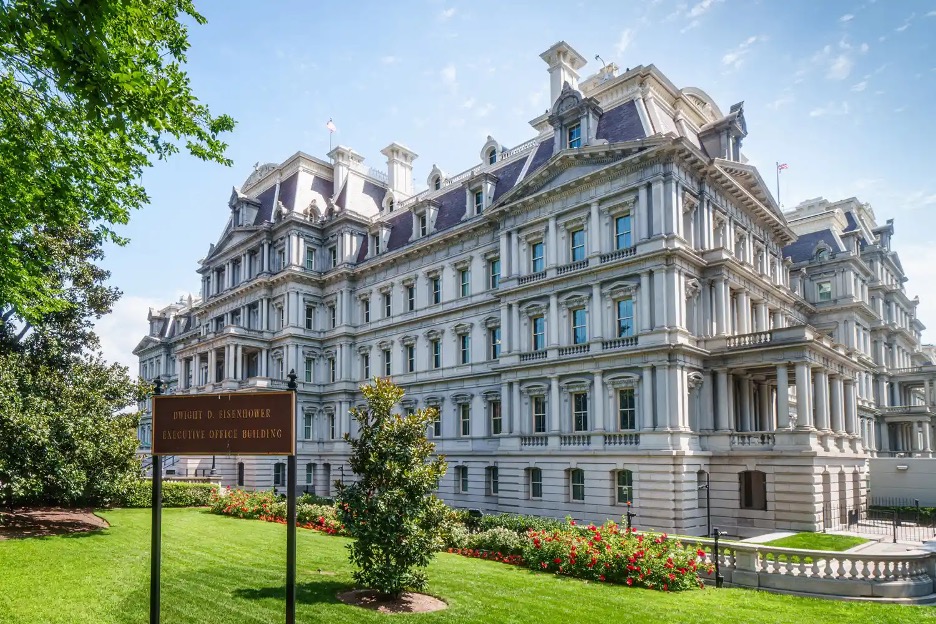
The Dwight Eisenhower Executive Office Building is seen on August 18, 2024, in Washington, DC. J. David Ake/Getty
White House Says Preservation Laws—and Courts—Are Powerless to Stop Project
DC, UNITED STATES, July 31, 2026 /EINPresswire.com/ -- Plaintiffs in the lawsuit (Case No. 1:25-cv-03969-DLF) challenging President Donald Trump's plan to paint the exterior of the historic Eisenhower Executive Office Building (“EEOB”) filed a renewed
motion for a preliminary injunction last night. The motion asks the Court to halt planned paint testing while it decides whether the White House lawfully assumed control of the Project from the General Services Administration (“GSA”), the federal agency Congress charged by Congress with protecting the building.The motion follows the Trump Administration's July 20 announcement that it intends to apply and then attempt to remove white mineral silicate paint directly to portions of the never-painted granite National Historic Landmark and cut out sections of stone for off-site study. Unless the Court intervenes, that work could begin as early as August 3, despite the government's earlier assurances that it would not move forward without first demonstrating compliance with the National Historic Preservation Act (“NHPA”) and the National Environmental Policy Act (“NEPA”).
Earlier this year, Plaintiffs voluntarily withdrew an earlier request for emergency relief after the government represented to the Court that it would not move forward while complying with the NHPA and NEPA. Plaintiffs contend that the circumstances have now changed precisely as the Court anticipated: the White House has announced that physical testing will begin while the threshold legal question of its authority to manage the Project remains unresolved.
The renewed motion argues that the proposed testing is itself part of the challenged Project—not merely preparation for it. Plaintiffs contend that the Administration unlawfully transferred responsibility for the Project from GSA to the White House Office of Administration ("OA"), an entity that asserts it is not subject to the preservation and environmental review laws that Congress imposed on federal agencies and whose actions Defendants contend are not subject to judicial review.
The motion states:
“The issue isn't whether the building should be studied. It is whether the White House can bypass the laws Congress enacted to protect historic places by taking over the Project itself. If the White House may simply assume GSA's responsibilities without assuming GSA's legal obligations, then those protections become optional.”
The White House has refused to disclose basic details about its testing plan, including who would perform the proposed work. Greg Werkheiser, founding partner of Cultural Heritage Partners and one of the plaintiffs, asked:
“Is it the same people who brought us the peeling paint of the granite Reflecting Pool? Or the surprise demolition of the East Wing? Or the dumping of hazardous debris from that demolition on a public D.C. golf course? The American people deserve the transparency required by law.”
The EEOB, completed in 1888 and adjoining the White House, is one of the nation's most recognizable government buildings and has served presidents for nearly a century and a half. Preservation experts have warned that applying a mineral silicate coating to the building's historic granite would require damaging preparation, permanently weaken the stone, and create ongoing maintenance obligations.
Plaintiffs argue that the implications of the case extend well beyond a single building.
“If the government can simply transfer project management to the President whenever it wishes to avoid the laws Congress enacted to protect historic places, no historic site will be safe from a President's personal whims,” Werkheiser said. “This case is about preserving the rule of law every bit as much as preserving a National Historic Landmark.”
Plaintiffs ask the Court to preserve the status quo by preventing further testing or implementation of the proposed painting project until the Court resolves the legality of the purported transfer of authority to OA and, if the Court determines that OA lacks authority, until GSA conducts the review required by the NHPA and NEPA through the procedures Congress prescribed.
The plaintiffs are the law firm Cultural Heritage Partners, PLLC, founding partners Greg Werkheiser and Marion Forsyth Werkheiser, and the DC Preservation League.
Cultural Heritage Partners, 1717 Pennsylvania Avenue NW, Suite 1025, Washington, DC 20006, info@culturalheritagepartners.com, (202) 567-7594.

No comments:
Post a Comment